
It is plain to see that the US senate bill's real objective is to derail India's time-tested strategic partnership with Russia, points out Ambassador M K Bhadrakumar.

A bipartisan group of US Senators has agreed to fast-track a bill allowing the President to impose sanctions on major purchasers of oil from Russia and Iran. This legislation, known as the Lindsey O. Graham Sanctioning Russia and Iran Act of 2026, aims to restrict funding for Russia's war efforts and Iran's energy and weapons sectors, potentially impacting countries like China and India through tariffs and other restrictions.

The Indian government and opposition are preparing for a contentious Monsoon Session of Parliament, with key issues including the Constitution Amendment Bill on delimitation and women's reservation, the alleged NEET paper leak, and a row over Ram temple donations set to spark heated debates.

Notwithstanding the economic complementarities and the host of agreements for deepening economic relation on a host of areas, both sides share common viewpoints on the foreign policy domain and seek common grounds to serve as a counterweight to China, notes Dr Rajaram Panda.

Leaders from several opposition parties within the INDIA bloc convened in New Delhi, stressing the critical need for unity to safeguard democratic values and address pressing issues like people's livelihoods, despite recent internal differences and electoral setbacks.

Education sector experts agree that using the "best technology" was essential to ensure students did not have to sit for an examination all over again because of a question paper leak.

India looks less equal to China than 5 years ago, the strategic alliance with the US is hobbled by trade, and Pakistan is looking anything but chastened by Balakot. What has gone wrong? asks Shekhar Gupta.

'We caught General Pervez Musharraf talking over the phone with his Chief of General Staff Lieutenant General Mohammad Aziz. Musharraf was visiting China; Aziz was in Rawalpindi.'

The harsh truth is that the US is no longer a reliable partner, cautions Ramesh Menon.

'At the end of the day, it is just another technology produced by the human mind.'

Indian stock markets this week will be primarily influenced by a series of corporate Q1 earnings, the evolving geopolitical situation in West Asia, and fluctuations in crude oil prices, according to market analysts.

The Central Board of Direct Taxes (CBDT) has released a 198-page guidance note to assist crypto-asset service providers in complying with reporting obligations under the Income-tax Act, 2025, aligning India with the OECD's Crypto-Asset Reporting Framework (Carf) for automatic exchange of tax information.

The Indian stock market is poised for a volatile week, influenced by the Reserve Bank of India's monetary policy decision, crucial global macroeconomic data, and the escalating geopolitical tensions in West Asia, according to market analysts.

India is one of the few nations, and perhaps the only nation, that has good relations with America, Israel and Iran. Knowing that a war in the Gulf would damage our economy, hurt supply of fertilisers and fuel, and cause general chaos, we should have tried to ensure this war did not begin, asserts Aakar Patel.

The Reserve Bank of India's Financial Stability Report indicates that the interim peace deal between the US and Iran has favourably shifted the balance of risks, reducing headwinds from the West Asia conflict. However, it cautions that exchange rate volatility could increase if crude oil prices spike due to delayed normalisation of supply chain disruptions.
Prime Minister Narendra Modi has urged for restraint in the use of petro products due to the West Asia crisis, emphasising the need to save foreign exchange and reduce the impact of war. He also highlighted India's progress in solar power and ethanol blending, while assuring support to Telangana's development.

S&P Global Ratings projects India's economic growth to slow to 6.6 per cent in FY27, down from 7.7 per cent in FY26, citing energy stress and a potential sub-par monsoon.

The question nobody seems to ask is why a democracy should be silent when many of its citizens are concerned about the way the US is deviating from its traditional ways of consultation, cooperation and collaboration and moving away from traditional allies, asks Ambassador T P Sreenivasan.

An intensified DVAC probe into a multi-crore liquor scam, allegedly involving former DMK Minister V Senthil Balaji, has led to a suggestion to privatise retail liquor sales in Tamil Nadu. The investigation targets alleged collusion in TASMAC bar licences, transport tenders, and procurement, with the Madras High Court dismissing Balaji's anticipatory bail plea. The FIR details systemic corruption, significant revenue loss, and illicit fund generation, prompting political reactions.

The Indian government has dismissed concerns that the use of E20 fuel could affect the validity of vehicle insurance policies, stating that the ethanol blending programme remains safe, consumer-friendly, and economically beneficial.

In the first-ever separate resolution on foreign policy brought in its National Executive in Bengaluru, BJP attacked the previous Congress-led Government, saying "a cursory glance at the 'lost decade' of the UPA, reveals retreat and a loss of direction in engaging with neighbours, ham-handed diplomacy vis--vis Pakistan and a blind-spot in our foreign policy to the Indian Ocean island states."

India's finance ministry anticipates inflation will remain relatively contained in the coming months, supported by a correction in crude oil prices and softening input costs following the cessation of the West Asia conflict, despite earlier spikes in wholesale and retail inflation.

Former Chief Election Commissioner S Y Quraishi has strongly criticised the Election Commission's ongoing Special Intensive Revision (SIR) of electoral rolls, stating it is 'focussed more on exclusion' and has 'played havoc with democracy' by disturbing free and fair elections.

Dhaka and Beijing on Thursday agreed to strengthen cooperation on the management of the Teesta and other rivers and signed 13 agreements to bolster bilateral ties following talks between Bangladeshi Prime Minister Tarique Rahman and Chinese Premier Li Qiang.

'After more than 12 years in power, he has been forced to retreat under public pressure. The education minister's resignation is the biggest political climbdown of his government so far.'

...exceeding their 49,340 crore equity selloff.

Larger NGOs could no longer work with smaller ones, especially those organisations working on the ground that had no means of or expertise in raising money themselves, reveals Aakar Patel.

External Affairs Minister S Jaishankar has strongly defended India's decision to purchase Russian crude oil, stating that the country's energy choices are based on cost and availability, and highlighting the West's 'hypocrisy' in criticising India while historically supplying weapons used against it.

'Foreign policy-making cannot be shifted out of Delhi and the regional satraps, who do not have a national perspective, should not be allowed to dominate foreign policy. But regional inputs should be integral to foreign policy-making at every step of the way,' says Ambassador T P Sreenivasan.

Market participants are keenly awaiting regular, preferably weekly, updates from the Reserve Bank of India (RBI) on Foreign Currency Non-Resident (Bank), or FCNR (B), deposits, following the central bank's directive for banks to submit daily data on these inflows.
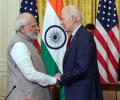
'For the first time since I've been following Indian politics, one heard voters talking about India's role on the world stage and the fact that, due to Modi's leadership, India was once again a great power.'

'Banking is the only sector that can see double-digit growth in FY27.'

'People don't like leaders who just crib and complain without offering a clear objective.' 'Theoretically and pragmatically, Rahul has to show an agenda beyond bad-mouthing Mr Modi on economic policies, foreign policy...'

Inflows into foreign currency non-resident (bank), or FCNR (B), deposits have significantly underperformed market expectations, leading to a more than 1 per cent depreciation of the rupee against the dollar this week. Analysts point to fading RBI support measures, tepid interest due to rising global bond yields, and narrowing interest rate spreads compared to 2013 as key challenges.

The government has intensified its Study in India programme and is working closely with universities and states to achieve this goal.

Chinese foreign policy will acquire a more ideological and less pragmatic character. It will be conducted with more nationalist overtones, predicts former foreign secretary Shyam Saran.

Indian benchmark indices Sensex and Nifty closed marginally lower due to profit-taking, following the Reserve Bank of India's decision to keep the repo rate unchanged while lowering its growth expectations for the current fiscal year and forecasting higher inflation.

The Congress party has alleged that convicted sex offender Jeffrey Epstein played a role in shaping the India-Israel relationship after 2014, citing email exchanges made public under the 'Epstein Files'.

Congress leader Jairam Ramesh said there are some parties that have expressed their inability to attend this particular meeting for their own reasons.

The Indian stock market's trajectory this week will be significantly influenced by crude oil prices, global market trends, and the commencement of the corporate earnings season, with IT major TCS set to announce its June-quarter results on July 9.
